When Mark from suburban Ohio noticed wide brown patches after a three-week heatwave, he tried running his old sprinkler for 10 minutes each morning — yet the lawn kept thinning. Across town, Maria's newly seeded front yard stayed dry at the roots because her quick, shallow watering evaporated before it soaked in. These are common U.S. homeowner scenarios: shallow, inconsistent watering that stresses grass rather than helping it recover.
Why consistent, deep watering works — and which problem it solves
The problem: most homeowners water too briefly or irregularly, which wets only the surface and encourages shallow roots. Shallow roots make turf fragile in heat, drought, and heavy use. The solution: water less often but more deeply so roots grow downward and the lawn stores moisture between cycles.
How deep is deep?
For established cool-season grasses (fescue, rye), aim for 6–8 inches of root-zone wetting; warm-season grasses (zoysia, bermuda) typically need 4–6 inches. That usually means applying 1 to 1.25 inches of water per week for cool-season grasses during the growing season, split into one or two sessions. According to the EPA, smart irrigation controllers can reduce outdoor water use by up to 30% compared with conventional timers, which helps keep those deeper cycles efficient (EPA WaterSense).
Real example: Mark swapped his five-minute daily run for two 30-minute sessions per week with a mobile sprinkler on medium flow. Within six weeks the grass had visibly thicker blades and a denser root mass measured with a simple soil probe.
Match the right setup to your yard: solutions by scenario
Think of RainPoint as a scenario irrigation expert that helps pick the right tools for your specific lawn. Below are common yard challenges and the watering setups that meet them — each pairing focuses on creating consistent, deep watering without wasting water.
Small lawn or front patch — DIY mobile sprinklers
Problem: small spaces often get overwatered because homeowners run sprinklers too long to cover a little area. Solution: a low-flow mobile sprinkler or oscillating head placed close to the turf and run for a single, longer session produces deeper infiltration. Try one run per week of 20–30 minutes, then use a soil probe to check moisture 4–6 inches down.
Example: A 500 sq ft front patch retrieved full color in four weeks when the homeowner replaced daily 8-minute runs with one 30-minute soak using a single, focused sprinkler head.
Large lawn — smart in-ground systems for consistent cycles
Problem: big lawns require coordinated zones. Short, daily watering wastes time and water. Solution: an in-ground system with zoning controlled by a smart WiFi timer lets you schedule longer soak cycles per zone, and pause automatically for rain.
A WiFi timer such as the RainPoint model lets you set multi-week schedules, create cycle-and-soak runs, and adjust for local weather. For example, use two 30–40 minute runs per week per zone in mid-summer, with a 30–60 minute soak between cycles if runoff starts. For a 0.25-acre lawn in Arizona, switching to a smart controller reduced weekly runtime by 25% while maintaining deeper soil moisture, according to local extension guidance.
Vegetable gardens, flower beds, and pots — targeted deep watering for different roots
Not every area of your yard needs the same approach. Match the method to plant type so deeper watering reaches the root zone without wetting foliage or causing runoff.
Vegetable gardens: precise drip irrigation
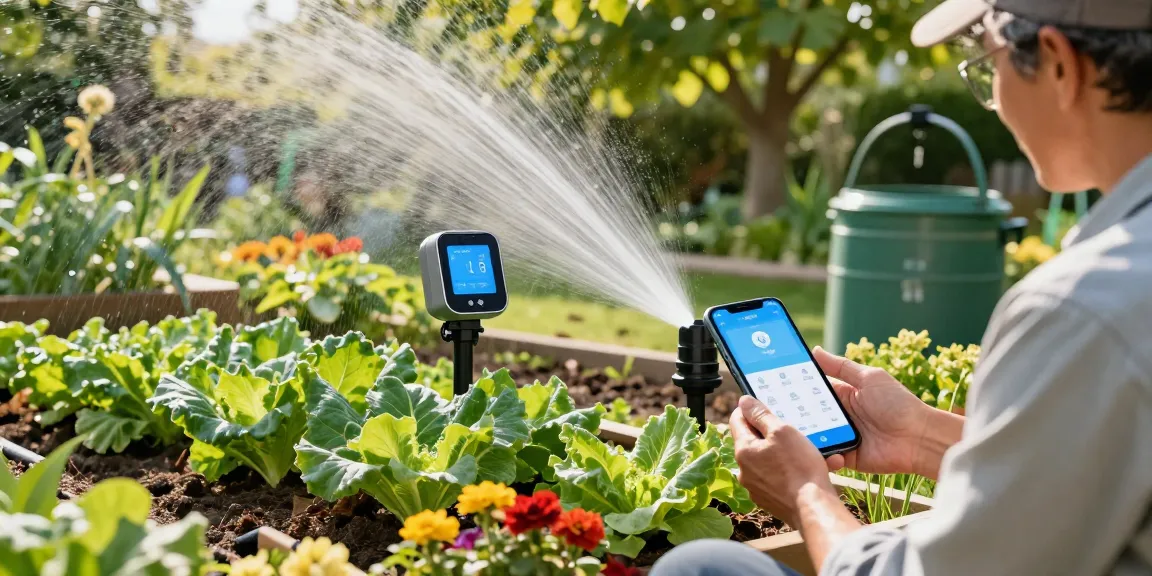
Problem: overhead water encourages disease and evaporates quickly. Solution: drip lines and emitters place water directly at the root zone in slow pulses that let it soak in. A complete drip kit tailored to bed length makes it easy to run one 30–60 minute session twice a week depending on soil and temperature.
Concrete case: a raised bed with tomatoes saw higher yields after the gardener installed a drip kit and switched from daily hose-soaking to twice-weekly 45-minute drips that wet the soil 6–8 inches deep.
Flower beds: soaker hoses and short soak cycles
Problem: flower roots vary but often benefit from frequent shallow pulses that still reach the root zone. Solution: soaker hoses laid at the crown provide gentle root-zone watering; run them for 40–60 minutes once or twice a week depending on soil. Soaker hoses reduce surface wetting and keep blooms healthier.
Potted plants: slow, steady self-watering
Problem: pots dry out fast, especially in heat. Solution: install self-watering spikes or small reservoir systems that deliver a slow, steady trickle. Those systems prevent the quick dry-down that kills seedlings and container plants.
How to set a recovery schedule and monitor progress
Problem: you don’t know whether your watering is deep enough. Solution: use simple tools and a schedule tuned to your soil type, lawn species, and weather. Clay holds water longer than sandy soils, so clay lawns need less frequent watering than sandy ones.
Practical steps:
- Measure current moisture with a screwdriver or soil probe — aim for wet soil 4–6 inches down for warm-season grass, 6–8 for cool-season.
- Use a catch cup to measure sprinkler output; adjust run times so each session applies the target 0.5–0.75 inches for a soak (total 1–1.25 inches/week for recovery).
- Check turf color and root depth after 3–6 weeks — look for new white root tips and firmer turf underfoot.
Grass TypeTarget Weekly WaterTypical Run PlanCool-season1–1.25 in1–2 sessions/week (e.g., 2×30–40 min)Warm-season0.75–1 in1 session/week or 2 short sessions (e.g., 45 min)
Example: Maria’s seeded front lawn on sandy loam needed two weekly soaks of 25 minutes with a medium-flow sprinkler. She checked with a soil probe at week two and saw moisture at 6 inches, so she cut back frequency to preserve water while roots strengthened. For a step-by-step scheduling method and cycle-and-soak guidance, homeowners can revive a dry lawn with consistent, deep watering by following recommended run lengths and soak intervals.
Tools and tech that make consistent, deep watering easier
Problem: manual timing is inconsistent and human error spikes water use. Solution: use the right mix of tech and simple gear to keep cycles reliable.
Tool pairings by scenario:
- Small lawn — mobile sprinkler + timer dial or smart plug to create one longer session per week.
- Large lawn — in-ground valves + a WiFi sprinkler timer to automate zone soak cycles and skip irrigation on rainy days. A WiFi timer from RainPoint can handle that schedule automatically and be adjusted from your phone.
- Vegetable bed — off-the-shelf drip kits with pressure regulators and emitters sized to plant needs.
- Flower beds — soaker hoses with mulch to reduce evaporation and hold moisture longer.
- Pots — reservoir-based self-watering systems or wicking spikes for steady supply.
Data point: the University of California Cooperative Extension recommends cycle-and-soak scheduling (short runs repeated with soak intervals) to reduce runoff and increase infiltration on slopes or compacted soils. Implementing these methods often reduces irrigation time while improving moisture at root depth.
Example: a homeowner with a sloped yard split each zone into three 15-minute cycles with 20-minute soak breaks; this avoided runoff and increased root-zone moisture within three waterings.