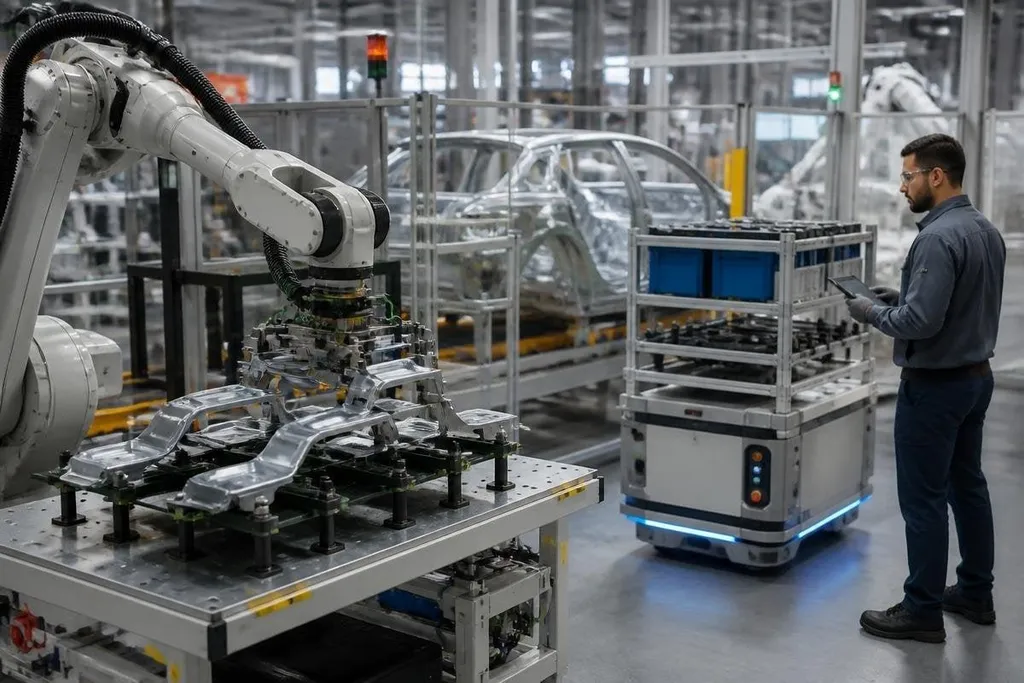
A factory robot can repeat the same weld for hours. The harder task is moving through a changing work area, handling parts with different shapes, and stopping safely when a person steps close.
Useful gains in automotive robotics will come from those practical jobs, not from a more polished demo.
- Robots that handle mixed parts without long setup work
- Better force sensing for fitting, sealing, and inspection
- Safety systems that let people and robots share work areas
Robots that can handle mixed parts
Most vehicle plants depend on fixed paths and fixed fixtures. That works when every body panel arrives in the same position, but it makes a new model or small batch costly to set up.
A more useful system can spot a part with cameras or LiDAR, plan a new path, and check its position during the task. The robot still needs a known work area and clear rules, but the job can move beyond one hard-coded sequence.
The proof will be simple: how many part types can the system handle, how long does setup take, and how often does it need a person to correct the path? A video of one successful pick won't answer those questions.
That evidence matters when a robot claims it can assemble vehicle parts. Automotive robotics reporting from Robot24.com can tie the claim to a named plant, task, date, and result, which is where force sensing starts to matter.
Force sensing for assembly
A camera can show where a part is. It can't tell the robot how hard the part is pressing against another surface. Force sensors measure that contact, which matters when a robot fits a connector, presses a seal, or guides a part into place.
During contact, the robot should slow down when resistance rises, correct its position, and stop when the force moves outside a safe range. That can cut broken parts and reduce the need for a worker to watch every motion.
The test should include misaligned parts and normal variation in size. A system that works only when every component sits in the exact expected place has a narrow use, even if the arm moves quickly.
Mobile robots inside the plant
A fixed arm can do one job well. A mobile robot can carry tools, parts, or inspection equipment between work areas, then stop at a new station when production changes.
That freedom adds new problems. The robot must map its route, avoid people and equipment, and keep its load stable while turning or stopping. Battery charging also matters because a robot waiting for power cannot move parts.
Look for results from a full shift rather than a short trial. Useful figures include distance traveled, stops caused by blocked routes, load weight, and time lost to charging or human help. Those figures say more than a top speed.
Inspection that catches small faults
Cameras already inspect many vehicle parts, but the hard part is deciding which marks matter. A useful inspection system needs a clear record of false alarms, missed faults, lighting changes, and the time needed to teach it a new part.
The best systems will connect inspection results to the production line. A detected fault should point to the part, location, and next action, so a technician can check it without searching through a long image file.
No evidence pack was supplied for this topic, so this article makes no claim about a named company, plant, price, or measured result. Those details are what buyers should ask for before treating a product announcement as factory progress.
A buyer's check before a plant trial
Use this list when a vendor presents an automotive robot for review:
- Ask for the task's full cycle time, including stops and handoffs.
- Count the part types the system handles without code changes.
- Check how the robot reacts to a misplaced or damaged part.
- Record the number of human interventions during a full shift.
- Price sensors, fixtures, software, training, service, and spare parts.
- Set a pass rule before the trial starts, then compare the result with the current process.
I'd skip any system that shows only a clean demo and hides the correction rate. A worthwhile automotive robot will show what happens when the part is late, the route is blocked, or the fixture is slightly wrong. That is where factory value will be measured.